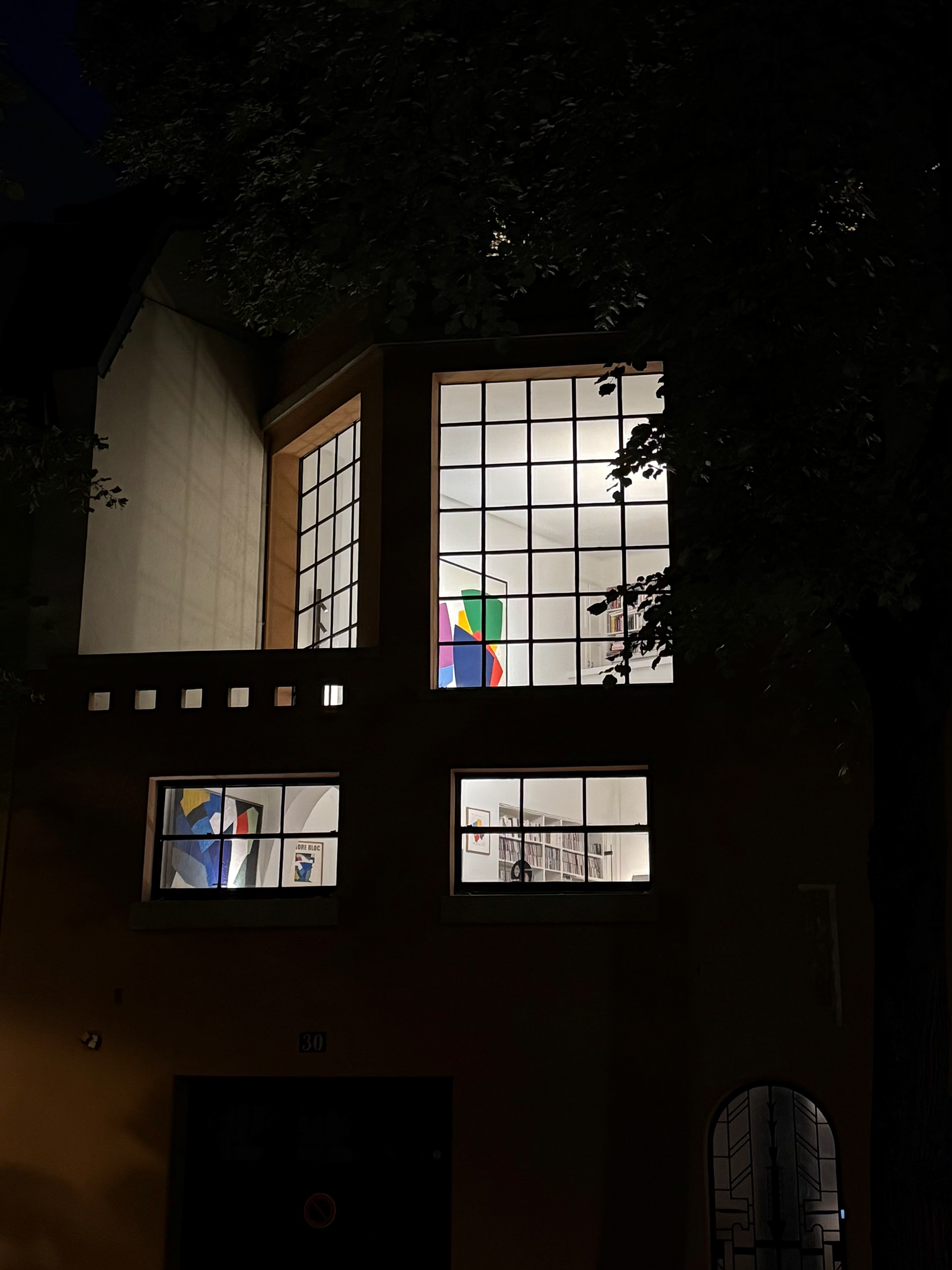
Last night, I found myself once again passing through Avenue Junot, perhaps the most inspiring street in Paris, at least for me, and for a certain few (a surprisingly effective way of testing relationships).
Avenue Junot’s beauty is not easily digestible. It isn’t just the architecture, or the cafés, or even the people that make the street feel special. it’s something more instinctive, it's a passionate feeling you get.
As I wandered around, I found myself, again, drawn to its grandiose Art Deco façades. While this time, I caught myself questioning the reason why. I couldn’t point to anything tangible. But I know myself well enough to recognize the pattern. What draws me in is a subtle darkness, the theatrically dramatic lighting, and those early modernist buildings with just enough ornaments on them to keep the dreaming intact.
From previous research, I knew that before Avenue Junot took its current form, this area was part of the “Maquis of Montmartre”, a marginal zone that emerged in the aftermath of the “Paris Commune”. It was inhabited by those pushed to the edges, sex workers, drifters, the so-called “outcasts.” Its destruction began in 1904, and by 1912, the grand, orderly street we now recognize had been constructed in its place. Remembering that, suddenly justified the energy I felt. And with that came larger questions, about modernism, darkness, and the role of glamour and dreaming within both.
I’ve come to think that glamour, in its truest form, has never existed without darkness. The two are not in opposition, as we often imagine, but essentially linked. The more I look at it, the clearer it becomes that glamour only reveals itself when it is touched by decay, not as a stylistic choice, but as a condition of honesty.
It has become increasingly difficult to look at the extreme wealth without seeing the shadow attached to it. There’s a collective understanding that fortunes on that scale, very rarely accumulate without a degree of violence. And so glamour, in its purest form, has always carried something slightly ominous within it.
What feels strange today is not that this darkness exists, but that it is being so carefully concealed by the contemporary elite. as if acknowledging the cost of glamour would somehow break the illusion. But the illusion is already quite fragile.
There is something almost refreshing, in retrospect, about the way older systems of power presented themselves. The excess was unapologetic and the hierarchies were visible in the visual language. It wasn’t necessarily better, but it was definitely more coherent. You could see the structure, and you could see your place within it.
Art Deco for example, in architecture and design, feels like one of the clearest expressions of this. The rigid geometries that would later influence authoritarian aesthetics, the colonial imprints and the visible excess during a time when the world was accelerating faster than it could process itself. It didn't attempt to conceal the violence of its moment. And in doing so, it produced a form of glamour that feels, in a strange way, more honest than contemporary aesthetics, which so often try to soften the structures they emerge from.
In the end, maybe the thing that kept me pulling to Avenue Junot was the trace of something unresolved beneath it all. The many different past lives, realities, tragedies behind the grandiose façades.